
Facility Improvements: Bringing Our Facility Into the 21st Century
Fundraising Target: $1.7 Million
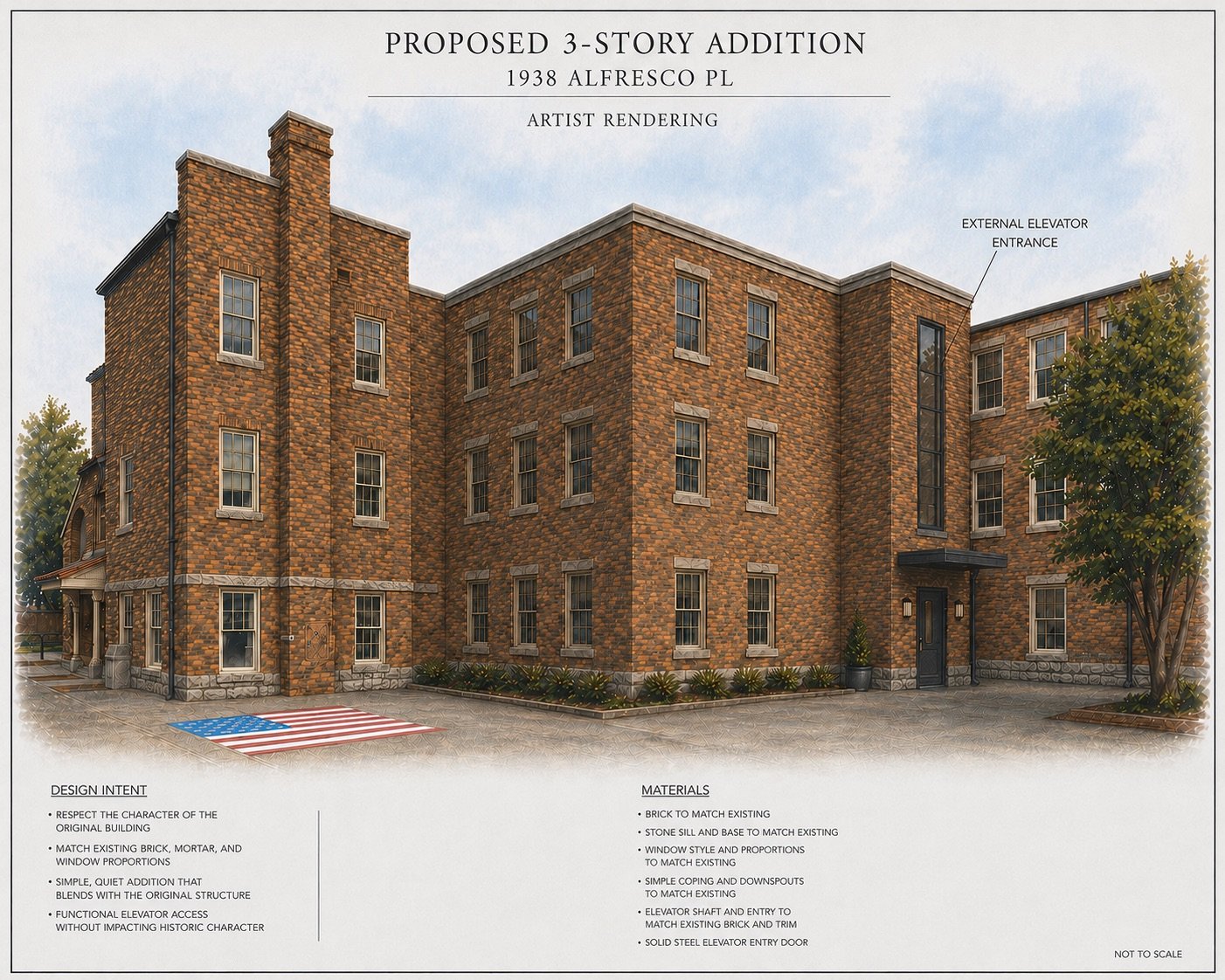
A New Vision for the Courtyard
The northwest corner of our building offers a unique opportunity to expand science facilities, add teaching space, and install a long overdue elevator.
There’s no doubt that by the standards of early 20th Century architecture, the design of SFA’s current building was a triumph. Its architects endowed it with every feature any grade school could have wanted at the time: ample natural light, broad hallways, offices, a library, a lunch room with a kitchen, faculty living spaces, and multiple staircases which offered fast and easy comings and goings from every corner of the building.
And while its designers and builders no doubt hoped the building would last SFA for a century or more, none of them could have anticipated how the needs of the school would change over that time. Today our building is still standing strong, albeit with some wear and a few conspicuous changes, foremost among them a gym with stained glass windows, architectural remnants of the SFA church, now standing next door, which temporarily occupied the space.
Jam Packed with Excellence
Over ten decades of use, SFA has maximized nearly all the space our builders originally gave us. A school that numbered just over 150 in 1926 now has nearly 250. A building originally designed to accommodate eight grades now contains a kindergarten, an after school care facility, and a Barton reading lab to accommodate students with learning differences.
Our third floor science lab, which presently occupies the space where the school’s nuns once lived, utilizes every square inch of cabinet, closet, and storage space that it has available to it — testament to the decades of award winning science fair projects that have been conceived and developed there.
It’s not an exaggeration to say that our faculty and staff have packed as many top-quality learning experiences as they possibly can into the available space. It’s past time we made room for more.
More Space for Learning
3 Floors — 3,600 Square Feet
The proposed building addition — which will take up a portion of the current courtyard — will add a total of 3,600 square feet to our building. Though not visible from the street, the addition will transform the experience of our north wing, supplementing the space we have now with three full classroom-sized spaces on three levels. The added space will allow us to:
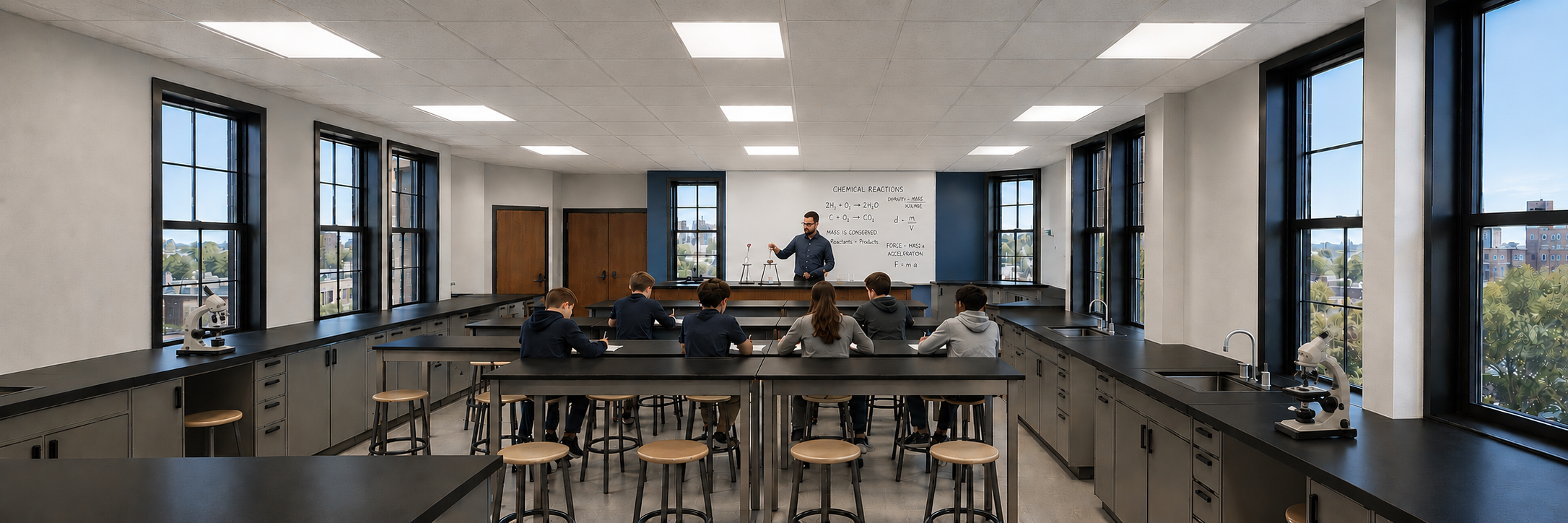
Expand & Refurbish Our Third-Floor Science Lab
Visitors to our current science lab can only marvel that a place so cramped and cluttered is in fact home to the state’s most lauded middle school science program. To say that the lab is overdue for an upgrade is a vast understatement. The current layout is suboptimal for lecturing, few if any of the lab’s chemistry sinks still function, and lighting is inadequate. Our students need more room in which to work and excel.
Add Needed Teaching Space
Ask any one of our staff or faculty what they would want if they could wish for anything at SFA, and the answer would be: space. Our current classrooms were designed for a day when students sat all day in just one room, at desks arranged in tidy rows facing a chalk board. Today’s teachers need more — and more flexible — spaces to accommodate more ambitious projects, and to conduct the kinds of educational programming that families of today increasingly want, and that students need.
For the First Time: Provide Complete Access to All 3 Floors of the Building
The clearest testament to our urgent need for an elevator is our basketball schedule. As things stand, the archdiocese gives St. Francis only a fraction of the games we once hosted — only because we are not an accessible facility. Of course sports are just once example of the handicap SFA currently lives with, simply because we don’t have an elevator. This is an infrastructure need which is, in truth, decades overdue.

Enrollment: The (Baby) Elephant in the Room
Without an Expanded Pre-K, It will be Virtually Impossible
for SFA to Compete in the Coming Years
Once, when times were different and there were fewer choices in schools, it was enough for a Catholic grade school to be just that: a grade school. As the demand for younger childhood education grew, most 1st-to-8th grade schools began adding kindergartens. SFA was one of them.
As the decades rolled along the popularity of day programs for even younger children — ages three and four — virtually exploded. The appeal was obvious. Working families got access to resources for the “middle” years between day care and kindergarten, and schools got a built-in student recruitment system that flowed from pre-K to Kindergarten, and right on into the grades.
The logic is obvious, yet despite the fact that SFA currently has a small pre-K, the small size of the program leaves us at a significant disadvantage relative to nearby schools.
Why? Because the size of our next-door facility limits our pre-K to just 16 children. That leaves us with an annual 10-student deficit that must be filled each year in order to fully populate our kindergarten. That’s harder than it sounds, particularly because most families that might otherwise consider SFA are already enrolled in Catholic 3-year-old-through-8th-grade programs. It’s simply too easy to stay there.
Given that, it’s easy to see where an expanded 4-year-old program (and perhaps even a three-year-old program) is essential for keeping SFA viable in coming years, with demographic shifts making the educational environment even more competitive.
Currently there is no space on our campus that can house such a program. The next-door property that houses our 16-child program can’t be expanded. The addition is, quite frankly, the only way to get the additional ground-level capacity we need.